
POSTECH-KRISS Team Develops a Power-Free Way to Detect Faint Structural Vibrations with Metasurfaces
- Writerkrissadmin5
- Date2026-08-11 00:00
- Hits240
POSTECH-KRISS Team Develops a Power-Free Way to Detect Faint Structural Vibrations with Metasurfaces

▲ (From left) Professor Rho Junsuk of POSTECH, Lee Geon, an integrated MS-PhD student at POSTECH, and Dr. Seung Hong Min of KRISS
A research team led by Professor Rho Junsuk of the Department of Mechanical Engineering, the Department of Chemical Engineering, the Department of Electrical Engineering, and the POSCO-POSTECH-RIST Convergence Research Center for Flat Optics and Metaphotonics at the Pohang University of Science and Technology (POSTECH), together with Lee Geon, an integrated MS-PhD student in the Department of Mechanical Engineering, announced on August 3 that they have developed a technology that uses metasurfaces to control the paths along which vibrations travel inside metal structures. The work was carried out jointly with a team of Dr. Seung Hong Min and Dr. Kim Seung Il of the Non-Destructive Metrology Group at the Korea Research Institute of Standards and Science (KRISS). Two related papers were published side by side in the same issue of Mechanical Systems and Signal Processing, a leading journal in mechanical engineering and signal processing, on August 1 local time.
Metamaterials are materials that perform special functions by realizing microstructures not found in nature. A metasurface is designed with patterns as fine as the nanometer scale (nm, one-billionth of a meter) on its surface, allowing it to control the direction and characteristics of waves such as light, sound, and vibration.
The two studies share a common approach: using metasurfaces to control the paths along which vibrations travel. One distinguishes between different types of vibration by sending each to a different location, while the other concentrates scattered vibration energy at a single point to strengthen faint signals.
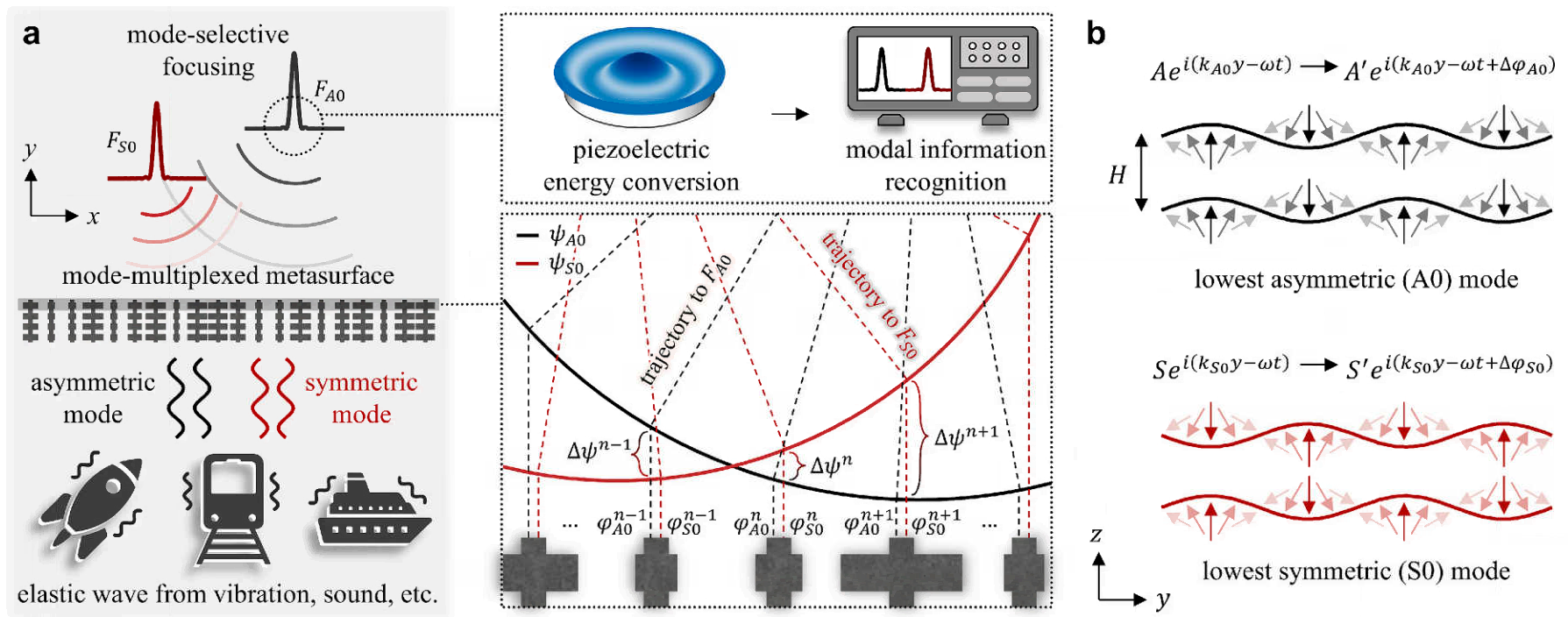
▲ Conceptual illustration of an elastic mode-resolver
© Lee et al., Mechanical Systems and Signal Processing, 2026
* (a) Schematic of the proposed elastic mode-resolver, which distinguishes elastic-wave modes through mode-selective focusing generated by a mode-multiplexed elastic metasurface. The inset illustrates the dispersion-engineering strategy that enables mode-multiplexing, showing the matching condition between the target phase shift ψ derived from generalized Snell's law and the realizable phase shift φ provided by a meta-atom array.
** (b) Schematic of the two fundamental modes of the lowest-order Lamb waves propagating along a plate of thickness H. Each mode accumulates a distinct phase shift during propagation.
The first study is a technology for distinguishing between types of vibration. Vibrations are divided into several modes according to the direction and form of their motion. Even within the same structure, these modes vary widely, such as bending up and down or stretching and compressing back and forth, so conventional approaches required measuring a wide area with multiple sensors and then performing complex calculations.
The research team precisely designed a metasurface that controls the paths along which vibrations travel, making it work like a "road sign." This structure guides vibrations to different locations depending on their mode, so simply checking where a vibration arrives makes it possible to physically identify the mode at once, without any separate, complex calculations.
The second is a technology for concentrating scattered vibration energy at a single point. In real structures, vibrations contain a mix of various frequencies, making it difficult to gather them at a specific location. The research team combined an elastic metasurface that controls the direction of vibrations with a gradient-index (GRIN) structure that gradually adjusts the speed of vibrations to naturally guide them toward the center. As a result, vibration energy converged at the center much like a black hole pulling in light, successfully concentrating vibration energy across the frequency range from 40 kHz to 100 kHz.
Both technologies operate without an external power source, and when combined with a piezoelectric element (which generates electricity when pressed or shaken), they can convert vibration energy into electrical signals. These technologies hold great potential for the safety diagnosis of large structures where power supply or sensor replacement is difficult, such as bridges, aircraft, pipelines, and storage tanks. Furthermore, they could be extended into self-powered monitoring systems that use the structure's own vibration energy to run low-power wireless sensors.
Professor Rho Junsuk's research team said, "This research began by viewing the vibrations inside a structure as a 'hidden language' that carries information about its condition." The team added, "We hope this technology, which designs the very paths along which vibrations travel, will become a new sensory organ for the future safety diagnosis of structures."
Meanwhile, this research was carried out with support from the POSCO Holdings N.EX.T IMPACT Metasurface-based Planar Optics Technology Lab, the Excellent Research and Mid-career Researcher Programs of the National Research Foundation of Korea (NRF), and a KRISS basic research project.
[Sources]
Electronic Times (etnews) | Reporter Jung Jae-hoon (jhoon@etnews.com)
POSTECH – News & Events – Department News
[References]
Lee, G., Kim, S.I., Seung, H.M., Rho, J. "Passive elastic mode-resolver with dispersion-engineered metasurfaces," Mechanical Systems and Signal Processing (2026).
https://doi.org/10.1016/j.ymssp.2026.114565
"Compound elastic concentrator for achromatic superfocusing and amplified energy harvesting over an ultra-broadband spectrum," Mechanical Systems and Signal Processing (2026).
https://doi.org/10.1016/j.ymssp.2026.114525